


In heavy industrial manufacturing, plant automation, and global energy distribution infrastructure, deploying a rugged waterproof connector system is a critical engineering priority to ensure environmental containment. For procurement directors, hardware architects, and plant engineers managing multi-million dollar capital equipment, the physical integrity of every electrical termination determines the operational uptime of the entire production line. A single point of moisture ingress without proper sealing can cause catastrophic short circuits, unexpected degradation of high-speed data packets, or sudden thermal failures.
When electrical systems encounter continuous water exposure, high-pressure chemical washdowns, or outdoor weather extremes, relying on consumer-grade splicing hardware introduces significant risk into your workflow. Industrial facilities require robust, factory-certified interconnect components built to survive extreme physical conditions. This engineering guide provides a detailed analysis of how to select, deploy, and audit high-reliability waterproof connection frameworks to safeguard your facility's infrastructure.
The Physics of Fluid Ingress: Why Standard Connections Fail
To understand why a heavy-duty waterproof connection layout is required on industrial floors, engineers must first evaluate how moisture penetrates an unsealed electrical junction box or wire harness. Fluid ingress typically occurs through three distinct physical mechanisms:
Capillary Action and Wicking
When a standard multi-strand wire harness experiences temperature shifts, air pockets within the insulation jacket expand and contract. This creates a localized vacuum. If the exposed end of a wire encounters moisture, this vacuum draws water directly up through the copper strands via capillary wicking. Once water enters the jacket, it travels along the core of the cable and directly into the internal electronics of the machinery.
Thermal Siphoning
Industrial machinery undergoes regular thermal cycling—heating up during peak shifts and cooling down during maintenance windows. This temperature fluctuation causes internal air pressure changes. Without a true interfacial compression seal provided by an industrial-grade waterproof wire connector, moisture-laden air is drawn into the contact chamber during the cooling phase, resulting in internal condensation.
Galvanic and Chemical Corrosion
When water containing electrolytes (such as dissolved salts or industrial cleaning detergents) bridges the gap between different metallic contacts, it triggers galvanic corrosion. This reaction quickly degrades copper pins and silver or gold platings, leading to an exponential increase in contact resistance, voltage drops, and localized overheating.

Deciphering Ingress Protection (IP) & Industrial Material Science
Selecting high-performance waterproof electrical connectors requires a clear understanding of international sealing standards and raw material formulations. A component's survivability depends heavily on its engineering shell and internal elastomeric seals.
The IP Rating Hierarchy for Factories
Most industrial procurement teams specify the Ingress Protection (IP) rating system defined under IEC 60529. However, the exact operating scenario determines whether an application requires static protection or high-pressure containment:
- IP67 Compliance: The component can withstand temporary immersion in water up to 1 meter depth for a fixed 30-minute test duration. This is suitable for equipment that faces occasional splashing or brief flooding.
- IP68 Compliance: Optimized for continuous submersion under water at specified pressures and depths. This rating is required for deep-well pump systems, maritime sensors, and underwater automated machinery.
- IP69K Compliance: The highest standard for environmental defense. Connectors must withstand high-pressure, high-temperature washdown jets delivering water at pressures up to 10,000 kPa (1,450 PSI) and temperatures up to 80°C. This is essential for food processing plants and medical facilities that require regular chemical sanitation.
Advanced Shell Polymers and Contact Metallurgy
To survive these extreme environments without cracking or corroding, industrial connector shells are molded from high-performance thermoplastic materials. Glass-fiber reinforced Polyamide 66 (PA66) and Polybutylene Tutylate (PBT) are chosen for their excellent dimensional stability, impact resistance, and ability to handle wide temperature swings without degrading or succumbing to UV radiation.
Inside the connector body, the choice of sealing compounds is equally critical. Premium designs utilize fluorosilicone or high-density ethylene propylene diene monomer (EPDM) O-rings. These materials retain their compression sets over thousands of mating cycles, preventing the seals from flattening out and failing when exposed to lubricants, ozone, and automotive fluids.
Terminal Mechanical Design & High-Current Realities
An effective waterproof wiring connectors framework must maintain excellent electrical conductivity while ensuring a perfectly sealed physical enclosure. If the internal pin design is flawed, mechanical vibrations can cause micro-disconnections, compromising both data and power delivery.
High-Current Torsion Spring Contact Systems
Standard stamped or split-tine pin configurations can fatigue under continuous physical stress, leading to contact gaps. Advanced industrial connectors employ proprietary high-current torsion spring contact architectures. This design features multiple independent spring contact points inside the female terminal sleeve, optimizing the overall surface area, lowering total contact resistance to milliohm levels, and preventing localized thermal spikes when running high continuous currents.
Mechanical Locking Engineering
To prevent accidental disconnection from high-frequency factory floor vibrations, heavy-duty connectors use structural mechanical locking rings. Depending on your field deployment speed requirements, engineering layouts generally utilize four key formats:
- Screw Lock: Traditional threaded configurations that offer maximum mechanical retention force for high-stress applications.
- Push Lock: Optimized for fast, toolless connection setups in dense control panels.
- Bayonet & Quick Lock: A rapid quarter-turn locking design that gives operators immediate tactile and audible confirmation of a secure connection.
Relevant Product Showcase
To streamline engineering integration on your production floor, procurement teams should utilize specialized components tailored to specific power, signal, and data requirements. Navigating standard catalog options can be difficult, so industrial operations are typically organized into clear categories to simplify selection.
Explore our full range of rugged field options on the Jnicon Products Landing Page and review detailed electrical and mechanical specifications across our main Jnicon Product Categories Page.

M16 2 Pin Waterproof Connector 10A Screw Locking IP68 for Industrial Controls
10A 2 pin screw-locking waterproof circular connector with IP68 rating, field installable or molded with cable for industrial control and instrumentation.

M19 RJ45 Waterproof Connector 8Pin IP68 Screw Locking for Industrial Ethernet
8-pin RJ45 waterproof Ethernet connector with IP68 rating and screw locking for reliable industrial network connections in harsh environments.
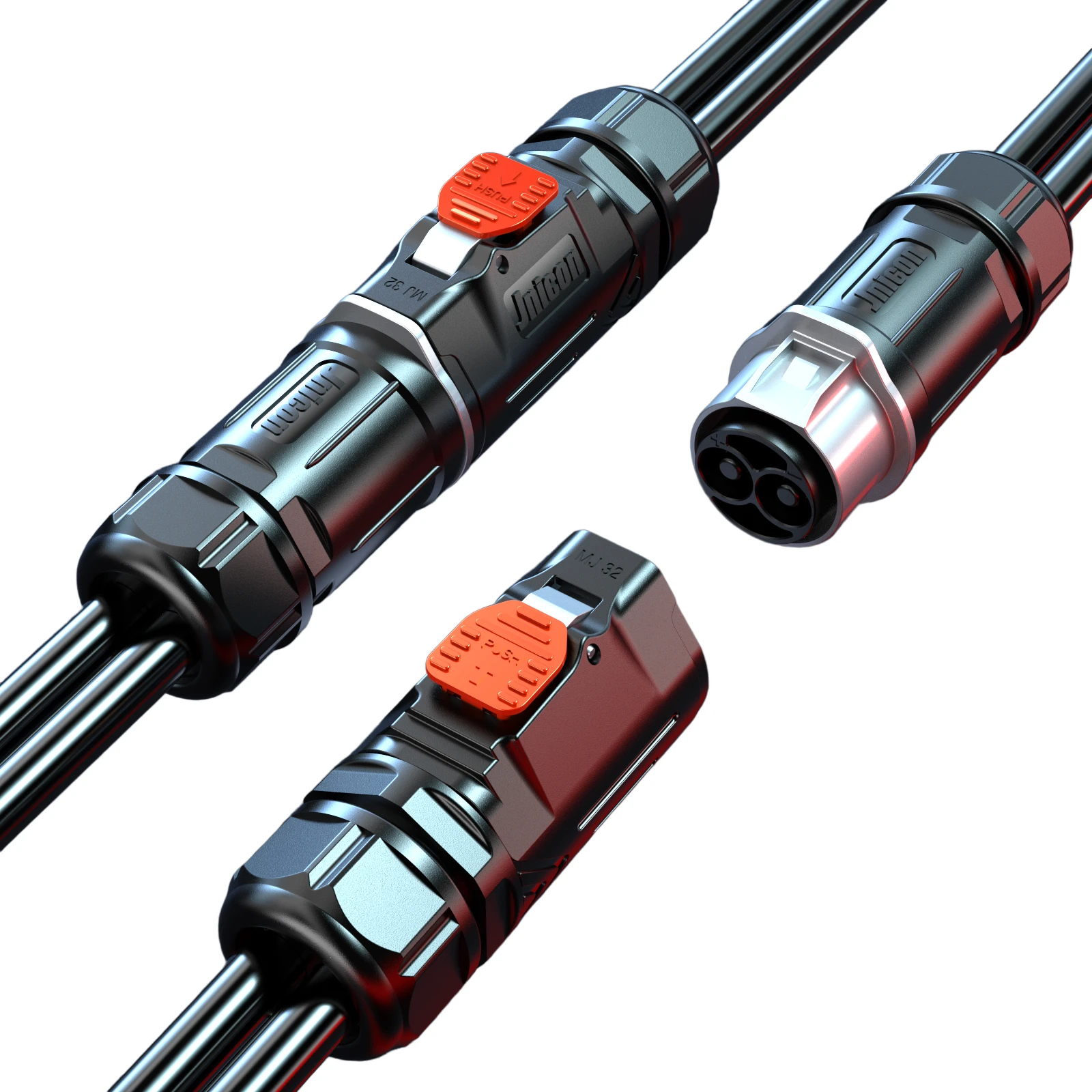
MJ32 2-Pin Waterproof Connector 120A Quick Lock for EV Charging
120A quick-lock waterproof connector for EV charging and energy storage, with IP67 protection and silver-plated contacts.
While residential or light commercial projects can use basic twist-on capsule options like dryconn waterproof connectors, these simple consumer components cannot survive the physical demands of a heavy factory environment. They lack the structural mechanical locking rings, rigid glass-filled thermoplastic housings, and certified chemical resistance required to survive continuous industrial operations.
Similarly, replacing precision machined connections with standard waterproof butt connectors or field-crimped waterproof wire connectors on a high-speed production line can introduce long-term failure points if the crimp tool calibration drifts. For critical factory operations, engineers specify fully overmolded, multi-pin plug assemblies that guarantee exact insulation resistance, controlled mating forces, and long-term protection against harsh environments.
Relevant Solution Case Studies
Industrial interconnect components must operate reliably across diverse and demanding environments. Standard off-the-shelf parts cannot handle specialized applications like sub-zero maritime environments or high-power energy storage systems. Customized engineering approaches are essential for addressing specific industry requirements:

Industrial Automation
Empowering smart factory infrastructures with certified power, signal, and data connectors. Engineered to withstand continuous multi-axis robotic motion, eliminate electromagnetic interference (EMI), and ensure zero-downtime performance in harsh manufacturing environments.
Explore Solutions
New Energy & Energy Storage
Safeguarding high-capacity grid infrastructures with certified high current connectors engineered to withstand massive voltage loads, minimize thermal buildup, and eliminate systemic arcing risks from cell to grid container.
Explore Solutions
Solar & Photovoltaic
Engineered for 1500V DC utility-scale solar farms and smart PV tracking systems. Our TUV/UL certified connectors eliminate DC arcing risks and withstand persistent UV degradation and sandstorms in desert environments.
Explore SolutionsThe Industrial Manufacturing Footprint
Partnering with an authorized waterproof connector manufacturer requires checking their underlying engineering assets, intellectual property, and quality control systems. A true manufacturing entity owns its entire production line, rather than outsourcing assembly to unverified sub-tier vendors.
Jnicon Group has been at the forefront of industrial interconnect development since 2013, evolving from a domestic manufacturer into an international enterprise backed by over 55 dedicated R&D engineers and holding nearly 300 active patents. This engineering foundation allows the group to quickly run deep structural simulations and compatibility reviews for custom industrial projects.
With an investment exceeding 500 million RMB across dual production facilities in Shenzhen and Shaoyang, Hunan, the company controls more than 50,000 square meters of highly automated manufacturing space. This infrastructure yields an annual production capacity of over 10 million sets of high-power industrial connectors, generating an annual output value above 1 billion RMB. These scaled manufacturing operations are managed under strict automotive-grade frameworks, holding active IATF16949 and ISO9001 quality management certifications alongside global safety approvals including UL, TUV, CE, 3C, RoHS, and REACH.
Before any batch leaves the production line, it must pass a series of stress tests within a certified in-house testing laboratory:
- Salt Spray Testing (Corrosion Resistance): Exposing components to continuous atomized salt solutions for 48, 96, or 720+ hours to verify housing and contact platings resist harsh maritime environments.
- Thermal Shock and Cycling: Cycling connectors between extreme low (-40°C) and high (+105°C) temperatures within minutes to ensure plastic housings do not crack, and internal seals retain their elasticity.
- Vibration and Mechanical Impact Profiling: Securing mated connectors to high-frequency vibration tables to ensure no electrical micro-disconnections occur under harsh harmonic stresses.
Conclusion: Securing Your Factory Interconnect Infrastructure
Maximizing operational efficiency across your production lines requires eliminating potential failure points before they manifest in the field. Investing in premium, factory-certified interconnect systems pays direct dividends by preventing unexpected downtime, reducing field maintenance expenses, and protecting expensive automation assets from moisture damage.
By focusing on verified Ingress Protection metrics, choosing advanced thermoplastic housings, and sourcing components directly from a high-capacity, certified manufacturer, procurement teams can build highly reliable system architectures. Protect your production infrastructure from environmental risks by working with an experienced, dedicated engineering partner.
For comprehensive technical documentation, 3D CAD step files, or to request a direct design consultation for your upcoming industrial project layout, connect with our global technical support representatives through our Official Jnicon Inquiry Page.