

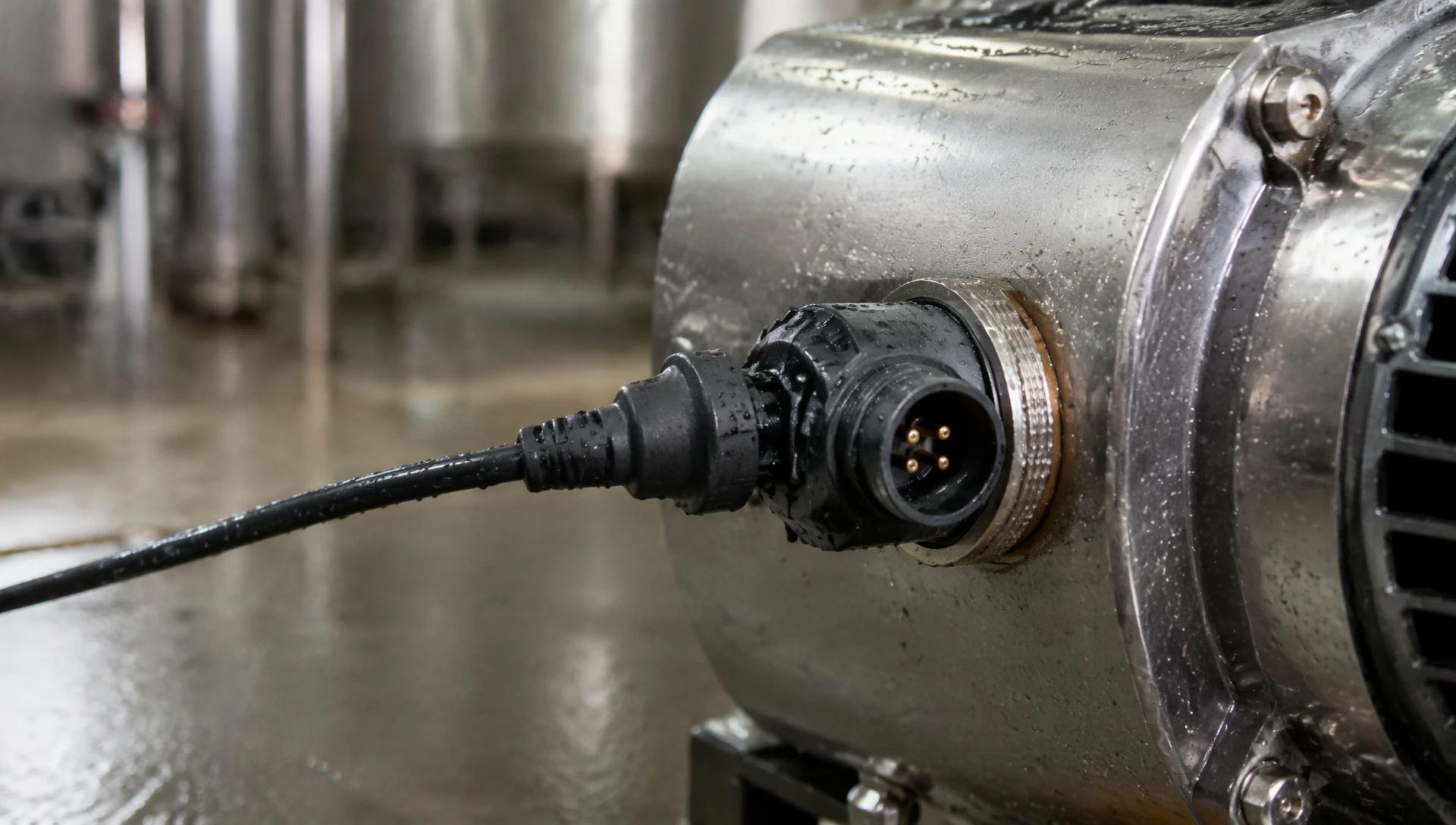
Unplanned machinery shutdown across automated production floors, commercial processing yards, and heavy industrial facilities is most frequently caused by a single, vulnerable point of failure: an unsealed or poorly terminated cable junction. When factory machinery operates in environments exposed to high-pressure washdowns, synthetic lubricants, oil mist, or severe atmospheric humidity, standard commercial wiring joints quickly suffer dielectric breakdown. Fluid wicking along stranded wire cores leads to immediate short circuits, signal corrosion, and breaker trips that halt entire manufacturing grids. For factory procurement directors, original equipment manufacturer (OEM) machinery builders, and electrical integration engineers, specifying a validated waterproof wire connector is an indispensable engineering decision to ensure uncompromised equipment uptime and long-term electrical safety.
Sourcing heavy-duty wiring components for factory-scale deployment requires evaluating suppliers beyond basic component brokers and catalog distributors. Partnering directly with an established original component manufacturer guarantees total control over engineering polymer formulations, terminal pin electroplating, and end-to-end quality validation. By establishing direct factory partnerships, industrial operations can customize exact wire entry glands, integrate high-performance sealing elastomers, and deploy power-and-signal hybrid configurations engineered to perform flawlessly across demanding mechanical, thermal, and chemical operating environments.
The Physics of Cable Junction Failures: Why Factory Wiring Fails
Understanding why standard electrical wiring fails under industrial duty cycles requires analyzing the fluid dynamics and thermal mechanics that occur inside an insulated cable harness during daily factory operations.
Thermal Vacuum and Capillary Wicking
A primary cause of hidden electrical failure in automated machinery is the capillary wicking effect driven by thermal cycling. During normal operation, electric motors, solenoid valves, and processing equipment generate substantial internal heat. This heat expands the small air pockets inside the stranded copper wire conductors and outer insulation jacket, forcing warm air out through the cable ends.
When the equipment shuts down at the end of a shift, the internal air rapidly cools and contracts, creating a localized vacuum inside the sealed wire jacket. If the exposed wire junction lacks a true hermetic seal, this pressure differential pulls ambient humidity, condensed water, or cutting fluids directly into the center of the stranded wire core. Through capillary action, moisture travels several feet inside the insulated cable, corroding the copper conductors from within until it reaches sensitive printed circuit boards (PCBs) or Programmable Logic Controller (PLC) input modules.
Dielectric Creepage and Arc Tracking
In power distribution circuits, moisture ingress degrades the surface insulation between adjacent electrical contacts. When conductive fluid splashes or airborne oil film penetrates an unsealed junction box, it forms a microscopic liquid path across the plastic carrier separating the positive and negative contacts. Under electrical potential, current leaks along this fluid path, causing localized heating that carbonizes the surrounding plastic. This carbon tracking permanently ruins the insulating properties of the plastic carrier, resulting in catastrophic dielectric breakdown and direct short circuits.
Preventing arc tracking requires maximizing internal creepage and clearance distances—the shortest paths along the insulator surface and through air between two conductive pins. High-grade industrial connector designs incorporate raised plastic isolation barriers between contact chambers, ensuring electrical isolation even when operating in high-humidity or splash-zone factory environments.
Mechanical Splice Design: Gel Capsules vs. Industrial Overmolded Pigtails
When designing field wiring layouts and OEM harness sub-assemblies, procurement managers must evaluate the mechanical trade-offs between field-assembled gel wire caps and factory-overmolded pigtail connectors.
Limitations of Commercial Gel-Filled Caps
In light commercial utility wiring or simple landscape irrigation, installers often use twist-on gel capsule connectors, such as a standard dryconn waterproof wire connector. These components rely on an outer plastic housing pre-filled with non-conductive silicone gel. When twisted onto bare wire ends, the silicone gel expands around the copper strands to displace air and block water entry.
While utilizing dryconn waterproof wire connectors can provide a budget-friendly solution for static, low-stress applications, basic gel caps are not engineered to withstand continuous industrial duty cycles. On high-speed manufacturing floors, constant machinery vibration can cause internal wire springs to back out over time. Furthermore, exposure to synthetic cutting lubricants, hydraulic oils, and high-temperature washdowns degrades the internal silicone gel, causing it to wash away or break down chemically. Once the gel barrier is compromised, bare copper wire ends are exposed to atmospheric moisture and rapid oxidation.
Engineering Advantages of Factory-Overmolded Pigtails
For high-reliability OEM machinery integration, factory engineering teams bypass loose gel caps and specify pre-molded pigtail sub-assemblies. Incorporating a pre-wired 2 wire pigtail waterproof male connector provides a completely solid, permanently sealed connection interface for two-wire sensors, DC solenoids, and auxiliary power feeds.
In an overmolded pigtail design, the internal copper wires are machine-crimped to solid-machined gold-plated pins. The entire rear wire transition is then encapsulated in molten polyurethane (PUR) or thermoplastic elastomer (TPE) under high pressure inside an injection mold. This overmolding process forms a chemical and mechanical bond with the outer wire jacket, completely blocking fluid from entering the rear exit of the plug. Pre-molded pigtails streamline shop floor assembly, eliminate operator wiring errors, and provide continuous IP68 ingress defense under heavy vibration.
For specialized boat trailer and marine harness applications, engineers should deploy heavy-duty waterproof wiring connectors for marine and trailer harnesses to block salt spray corrosion.
Circuit Topologies: From Low-Voltage Signals to Multi-Pin Power
Modern factory grids require diverse wiring architectures depending on operating voltage, current capacity, and signal sensitivity. Sourcing managers must match connector topologies to specific machine control loops.
Low-Voltage Telemetry and Sensor Networks
Low-voltage direct current (DC) networks—specifically 12V and 24V DC circuits—power proximity sensors, digital flow meters, optical scanners, and automated guided vehicle (AGV) tracking modules across modern automated plants. While low voltage reduces arc-over risks, low-voltage control loops are exceptionally vulnerable to signal drift caused by microscopic contact oxidation.
When ambient humidity breaches an unsealed low-voltage junction, the continuous DC potential triggers electrochemical electrolysis across adjacent pins. This reaction forms a non-conductive layer of oxidation on the pin surface. Because the system operates on low voltage, even a tiny increase in electrical resistance disrupts delicate milliamp signals, leading to false sensor readings or unexpected safety shutdowns.
Deploying high-integrity low voltage wire connectors waterproof units eliminates signal corrosion through dual-stage protection. Internally, the contact pins undergo multi-stage electroplating, applying a dense nickel undercoat followed by a heavy gold surface layer. Gold remains chemically inert, maintaining minimal contact resistance across thousands of mating cycles. Externally, precision elastomeric seals isolate the junction from plant humidity. For outdoor sensor nodes and wet-zone processing lines, selecting certified waterproof low voltage wire connectors ensures uncompromised data integrity.
Single-Phase AC Power and Equipment Branching
For primary single-phase AC power input (Line, Neutral, Ground) feeding motors, pumps, and utility power distribution, engineering teams deploy a robust 3 wire waterproof connector. These 3-wire interfaces feature larger contact pins capable of carrying high current loads while maintaining wide internal creepage distances between phases.
When a main power trunk line needs to feed multiple drop lines along a conveyor grid, integrated T-junction or Y-junction splitter blocks enable clean branching without requiring custom junction boxes. Utilizing a 3-wire circular connector setup ensures that every branch point maintains a consistent IP68 waterproof seal while simplifying field maintenance.
Multi-Channel Signal Distribution
As machine automation density increases, routing individual two-wire cables to every sensor becomes impractical due to panel space limits and cable drag. In these applications, machine designers combine multiple sensor signals into a single multi-core trunk cable using a compact 6 pin waterproof wire connector.
A 6-pin circular interface allows routing multiple power and control channels within a single space-saving housing. High-quality 6-pin connectors feature raised plastic isolation walls between contact chambers and polarized internal keyways to prevent cross-mating during field servicing.
Exposed Outdoor Facilities and Infrastructure
For utility installations, solar tracking arrays, commercial marine docks, and outdoor agricultural facilities, wiring systems encounter constant UV radiation, heavy rainfall, and seasonal temperature extremes. Installing rugged outdoor waterproof wire connectors constructed from UV-stabilized Polyamide 66 ensures that external connector shells will not become brittle, crack, or lose sealing compression over years of direct exposure to sunlight and freezing weather.
To mitigate voltage drop in 12V auxiliary power loops, deploy a certified 12V 2 pin waterproof connector to isolate contacts from plant humidity.
Advanced Material Science: Polymers, Elastomers, and Strain Relief Mechanics
The operational lifecycle of a waterproof electrical interface depends directly on the quality of its underlying raw materials and mechanical strain-relief engineering.
Engineering Thermoplastics for External Housings
The outer shell of an industrial circular connector serves as its primary mechanical and chemical shield. Leading component producers avoid generic commercial plastics, selecting glass-fiber reinforced Polyamide 66 (PA66) or Polybutylene Terephthalate (PBT). These engineering polymers offer high tensile strength, high heat deflection temperatures, and superior resistance to chemical solvents. Industrial PA66 retains its physical properties when exposed to synthetic cutting lubricants, hydraulic oils, diesel fuels, and mild acid washdown solutions, preventing surface micro-cracks that would otherwise compromise sealing gaskets.
Elastomeric Sealing Rings and Compression Set
Achieving a long-term water-tight seal requires matching the rigid plastic housing with high-performance elastomeric seals. Internal O-rings and perimeter gaskets typically feature Fluorosilicone or Ethylene Propylene Diene Monomer (EPDM) rubber.
These technical elastomers are selected for their high compression set resistance—their ability to rebound and maintain outward sealing force against metal or plastic mating walls even after thousands of hours of tight compression. Fluorosilicone, in particular, remains flexible at minus 40 degrees Celsius and stable at plus 105 degrees Celsius, ensuring that temperature swings do not shrink internal seals and allow moisture entry.
Strain Relief Gland Mechanics
A frequent point of mechanical stress occurs where the flexible wire cable exits the rigid rear body of the connector. If a cable is pulled, twisted, or flexed during machine motion, the physical stress can pull wire strands away from internal terminal crimps or gap the rear sealing grommet.
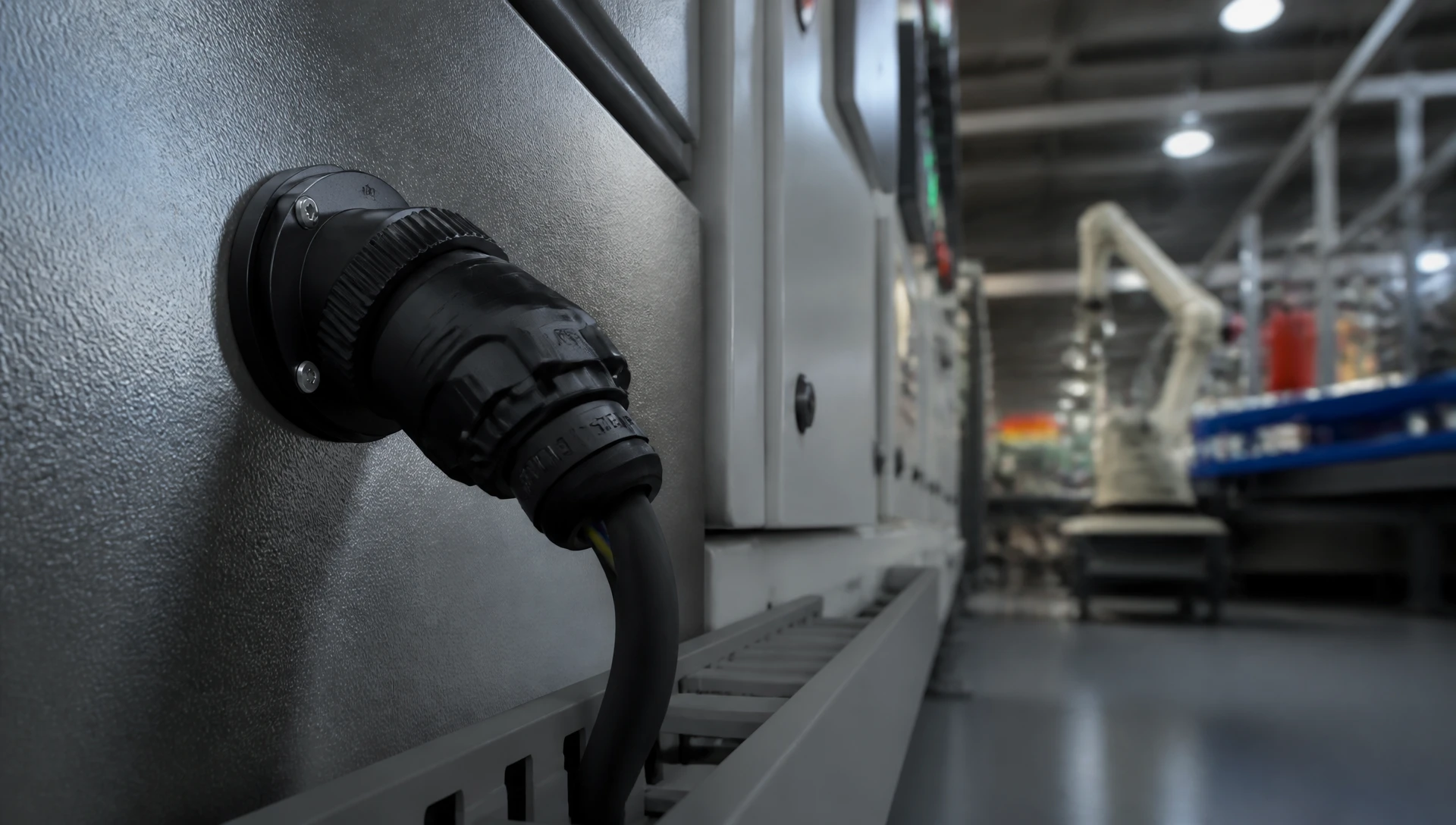
Industrial circular connectors incorporate integrated compression strain-relief glands at the rear cable exit. When the rear locking nut is torqued down, an internal segmented plastic collet compresses a flexible elastomeric grommet tightly around the outer cable jacket. This design achieves two critical functions:
-
360-Degree Radial Sealing: Compresses the grommet evenly around the cable jacket to block water migration along the outer insulation.
-
Mechanical Cable Retention: Transfers physical pulling and twisting forces to the tough outer cable jacket and plastic collet, protecting internal crimped wire terminations from mechanical fatigue.
Recommended Industrial Product Lineup
To assist procurement managers and systems engineers in selecting the ideal component platform for their facility needs, we maintain distinct product families engineered for specific current capacities, custom configurations, and operational environments.
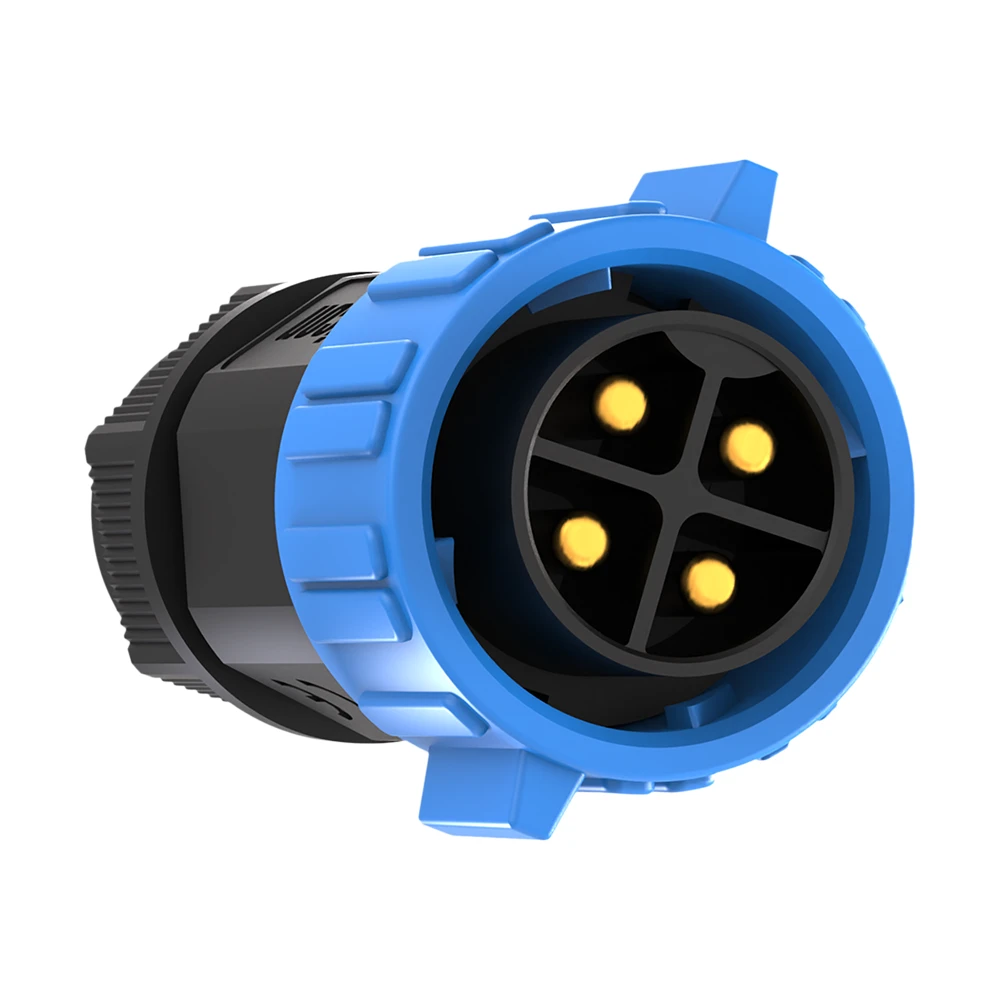
M25 4-Pin Waterproof Connector 50A Push Locking Field Installable for Industrial Automation
Field installable 50A 4-pin push-locking waterproof connector with IP67 protection, ideal for on-site wiring in industrial automation and control panels.
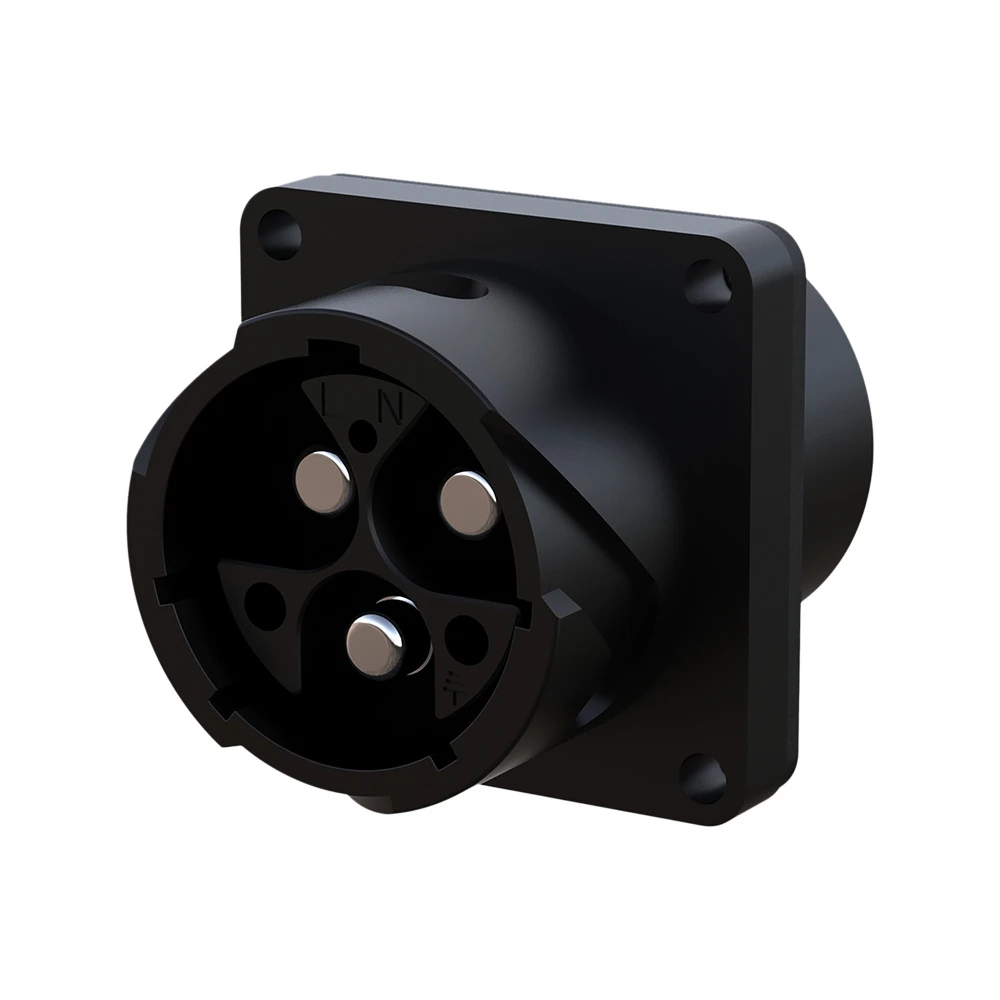
M28 3-Pin Waterproof Connector 80A Bayonet Locking IP67 for Solar & Storage
80A 3-pin bayonet-locking waterproof circular connector with IP67 rating for solar photovoltaic and energy storage systems.
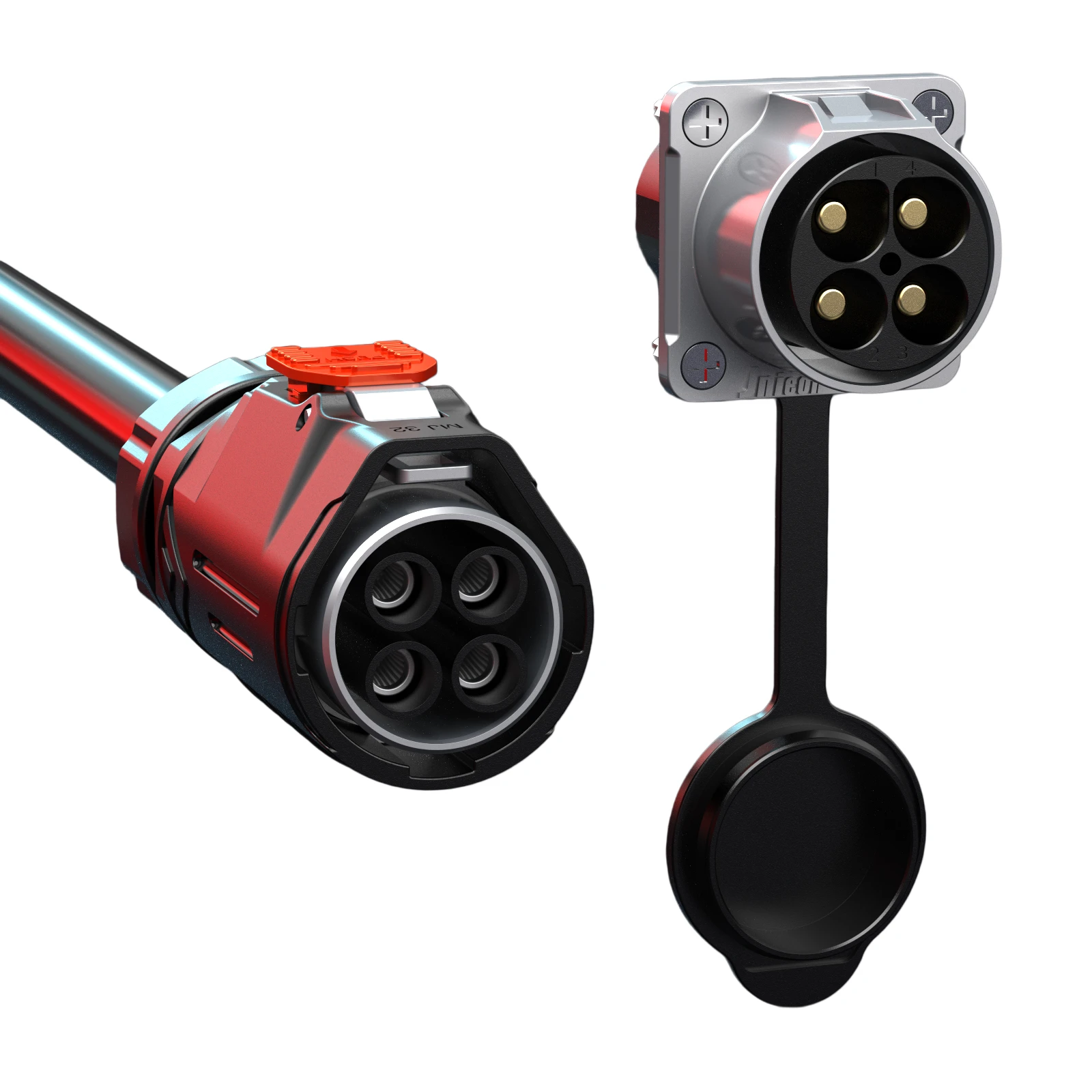
MJ32 4-Pin Waterproof Connector 80A Quick Lock for Energy Storage
80A quick-lock waterproof connector for energy storage and industrial power, with IP67 protection and reliable power transmission.
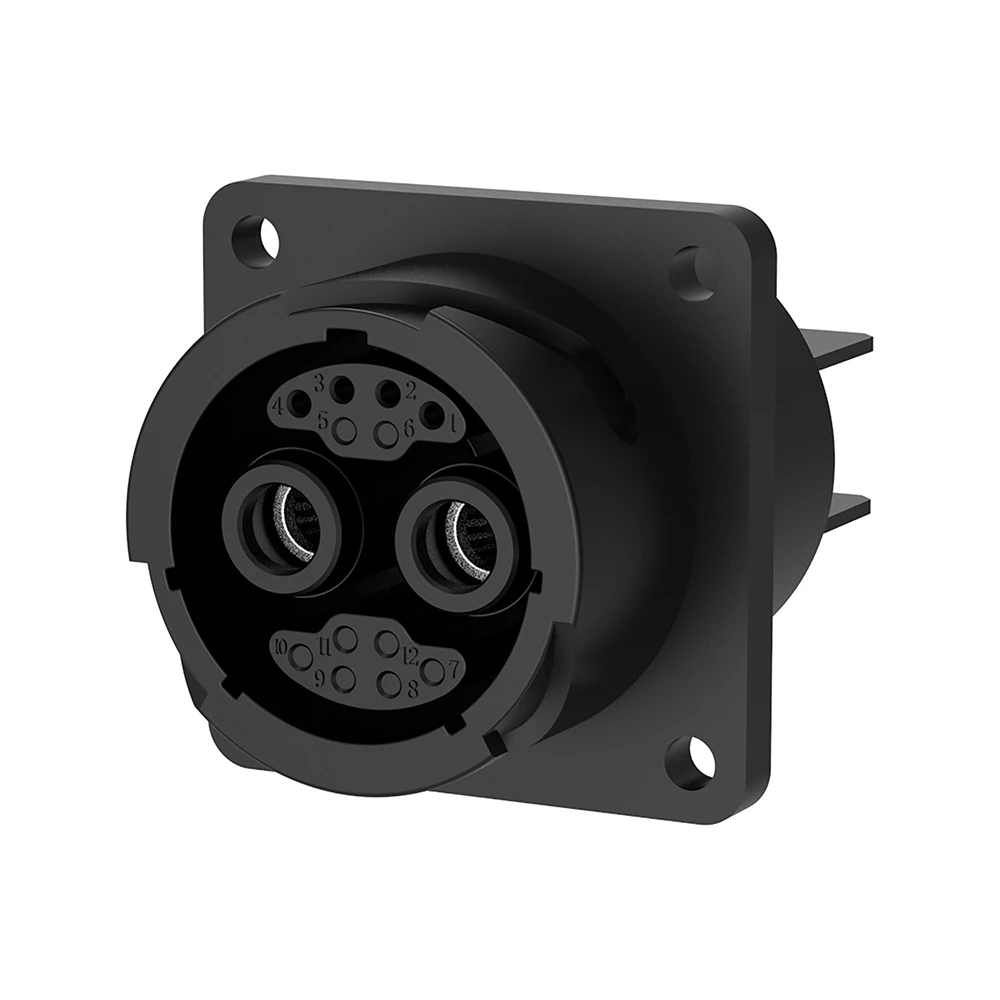
M40 2+4 Pin Hybrid Waterproof Connector for Power and Signal
120A+10A hybrid bayonet lock waterproof connector combining power and signal in one compact design.

M19 5 Pin Waterproof Connector 15A Push Locking IP67 for Power Systems
15A 5 pin push-locking waterproof circular connector with IP67 rating for industrial power and marine systems.
To view complete technical specs, dimensional prints, and datasheets across our full hardware catalog, explore our comprehensive Circular Connectors Portfolio and main Product Center.
Recommended Industrial Solution Frameworks
Factory infrastructure management extends beyond individual hardware selection to complete electrical distribution architectures. Sourcing from an established manufacturing partner provides access to fully validated engineering frameworks tailored to challenging industrial environments.

Industrial Automation
Power, signal, and data connectivity for factory machines, robotic cells, sensors, and control cabinets. JNICON can review circular connectors and cable assemblies against motion, sealing, shielding, and maintenance requirements before prototype approval.
Explore Solutions
New Energy & Energy Storage
Connector and cable assembly options for battery racks, BMS interfaces, power conversion equipment and energy-storage cabinets. JNICON supports configuration review based on current, voltage, thermal conditions, polarity, service access and environmental exposure.
Explore Solutions
Marine & Offshore
Sealed power, signal and cable interfaces for marine equipment and offshore installations. Review salt exposure, condensation, vibration, cleaning and service conditions with JNICON. A stated IP68 rating does not by itself establish continuous subsea, pressure-depth or marine-class approval.
Explore Solutions
Outdoor Lighting & LED
Power and control connections for outdoor luminaires, architectural lighting and LED installations. JNICON can review connectorized cables, locking styles and sealing arrangements against driver loads, cable dimensions, weather exposure and maintenance needs.
Explore SolutionsTo review detailed operational case studies and access industry-specific technical blueprints, browse our complete Industrial Solutions Directory and explore our dedicated Connectors Category.
Quality Audits and Manufacturing Validation Frameworks
Sourcing electrical components for critical industrial grids requires working with an original manufacturer that maintains rigorous quality controls and transparent factory validation procedures. Relying on unverified trading companies introduces risks of component failure if sub-assemblies lack comprehensive testing.
An authentic, high-quality component factory maintains accredited international quality management systems, specifically ISO9001 for corporate quality control, IATF16949 for automotive-grade supply chain tracking, and ISO14001 for environmental management. These audited operating procedures ensure consistent component quality across multi-year purchasing contracts.
Prior to mass delivery, production samples undergo rigorous laboratory validation:
-
High-Pressure Hydrostatic Testing: Sub-assemblies are submerged in pressurized testing vats past 1 meter depth to confirm IP68 sealing integrity.
-
Thermal Shock Cycling: Connectors are cycled between minus 40 degrees Celsius and plus 105 degrees Celsius inside environmental chambers to verify that plastic bodies do not warp or crack.
-
Salt Spray Corrosion Testing: Assembled components endure extended salt fog exposure to confirm that plating layers prevent contact oxidation.
To learn more about auditing factory quality systems and evaluating manufacturing capabilities, read our technical guides on analyzing an industrial connector manufacturer for harsh grids and our comprehensive waterproof connector sourcing guide for industrial plants.
Frequently Asked Questions (FAQ)
Conclusion: Partnering for Reliable Industrial Sourcing
Optimizing your facility's electrical infrastructure requires looking beyond low-cost parts and carefully evaluating a supplier's engineering capabilities, quality control systems, and raw material tracking. Sourcing components directly from a trusted manufacturing partner protects your equipment from field failures and helps stabilize your assembly line costs. The Jnicon engineering team is ready to support your business with a wide selection of standard circular connectors or completely customized hybrid cable assemblies. To request detailed technical spec sheets, arrange a digital factory audit, or receive a project quotation, connect with our support team through our direct Inquiry and Contact Portal.